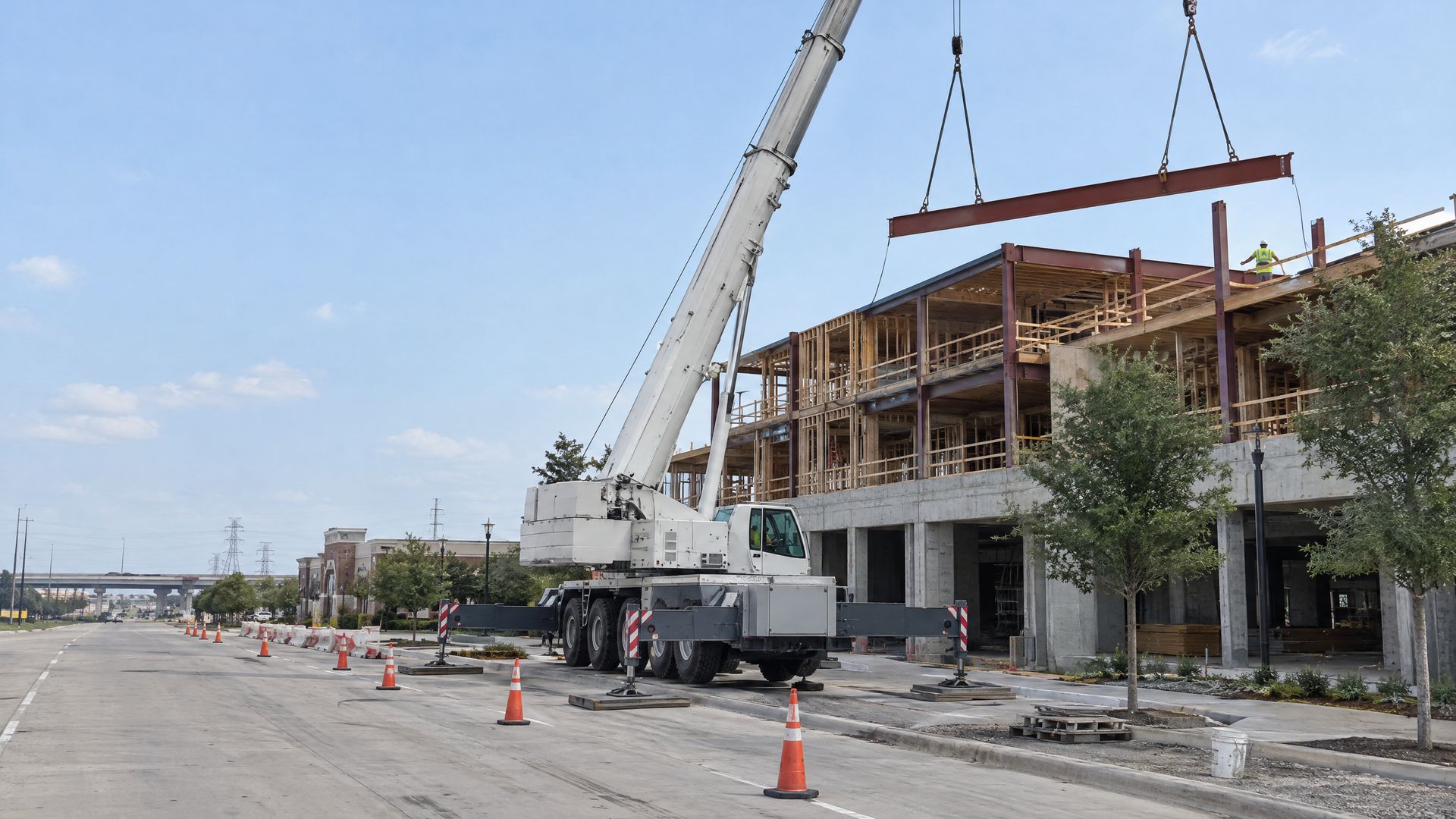
Crane Rental in Cedar Hill, TX
Cranes and heavy equipment in Cedar Hill work around three local conditions: limestone hills, Joe Pool Lake and a US 67 corridor under reconstruction. The Handbook of Texas places the town "in the rolling hills of southwestern Dallas County," and the City says Cedar Hill "falls within both Dallas and Ellis Counties." Texas Parks and Wildlife's Cedar Hill State Park page gives the park, on Joe Pool Lake, an elevation of 616 feet among "rugged limestone hills," and the Cedar Hill Economic Development Corporation (EDC) puts the city at "the northern edge of the Balcones Escarpment." On ground like that, the first question for any crane is where it can stand level.
Two staffing choices apply to every Cedar Hill crane. With an operated crane, the hourly rate covers the operator too, and a minimum charge applies; with a bare crane, the machine is yours to staff, and your operator must qualify under OSHA section 1926.1427. We price the work in writing first, at no charge, line by line: the crane or machine, who staffs it, hours or term, delivery, and any extras (permits, escorts, crane mats, rigging), then tax. The cost page with published rental ranges shows each class's range with its source and date. The Texas Comptroller lists Cedar Hill at 8.25 percent total sales tax in both its Dallas County and Ellis County parts.
each crane, lift and machine gets a written quote before any date is set.
Free quote
Limestone Hills, Joe Pool Lake and the US 67 Rebuild in Cedar Hill
Cedar Hill's terrain is the first thing a lift plan has to answer. The EDC calls the city "the beginning of the Texas Hill Country," with "over 4,000 acres of green space," and cites a "Strong city commitment to protect 25% of Cedar Hill's land as undeveloped open space." Inside Cedar Hill State Park, TPWD says the DORBA mountain-bike trail "crisscrosses 1,200 acres" of the park, and a May 2026 report posted by the EDC credits the city's Great Greenway with "2,800 acres of natural landscapes" and "over 35 miles of trail." On terrain like this we ask about the grade at the setup spot, the access route and the soil before choosing the crane and its mats, the timber or steel panels that spread a crane's weight over soft or uneven ground.
Joe Pool Lake brings its own conditions to nearby work. The Texas Water Development Board says Congress approved the project in 1965 and the lake "was filled by June 1989"; the Handbook of Texas says Cedar Hill grew "especially after 1989 when Joe Pool Lake opened nearby." TWDB's 2022 survey measures the lake at 6,680 acres at the top of its conservation pool, 522 feet above mean sea level, and 10,114 acres at flood pool, and the U.S. Army Corps of Engineers, which operates it for water supply, flood control and recreation, counts 64 miles of shoreline. The Corps adds that "All of the parks at Joe Pool Lake are outgrants to State or City Agencies," so a job inside a lake park involves the agency that holds it. The figures are on TWDB's Joe Pool Lake page; for the portion of the lake in southern Grand Prairie, see our Grand Prairie page.
A new US 67 interchange at Lake Ridge Parkway is on TxDOT's construction list. That Dallas District list, dated June 2026, gives Phase 1 a summer 2026 start and an estimated spring 2029 finish, and the EDC describes "a new grade-separated interchange at Lake Ridge Parkway" with "reconstruction of portions of the US 67 main lanes and frontage roads," in an area running from north of Shiloh Road to south of Mount Lebanon Road. The EDC adds that Loop 9's Segment A "is planned to extend approximately 9.4 miles from US 67 to I 35E through Dallas and Ellis counties." Cranes and deliveries headed for sites along US 67 may meet that work zone into 2029, so TxDOT's current traffic pattern is part of every route we plan there. The EDC's account is in its Loop 9 and interchange article.
Cedar Hill's industrial growth runs along US 67 and the rail line. The EDC reports "More than 4 million square feet of industrial space recently completed or in development," says the Industrial District has "access to major interstates and BNSF rail service," and names three logistics parks: Cedar Hill Logistics Park on Mt. Lebanon Road, Cedar Hill 67 Logistics Park on Elmer Weaver Freeway, and High Point 67. Among the brands it names are Delta Steel and Pratt Industries, plus a retailer's distribution center. Buildings like these need cranes while steel and rooftop units go up, then forklifts, scissor lifts and telehandlers once they are running. The district overview is on the EDC's Industrial District page.
Cedar Hill's retail and civic districts bring a different scale of lift. The EDC describes Historic Downtown as "A 300-acre district" with "ongoing streetscape improvements," Uptown's Hillside Village as "600,000 square feet of retail space with 11 acres available for new development," an Uptown multifamily project of "300+ units," and West Midtown as "a 90-acre area inclusive of the city's major civic institutions." In Midtown, the City reported on August 26, 2026 that the Council had approved a Go Ape adventure park at its August 25 meeting, alongside an upgrade under way at the Cinemark theater. Signs, glass and rooftop units in districts like these suit boom trucks, spider cranes and aerial lifts.
See Cedar Hill, TX on Google Maps — we quote work in this city from Arlington.
Cranes for Cedar Hill Slopes, Lakeside Lots and Industrial Parks
Picking a crane class in Cedar Hill starts at the setup spot, because the hills can leave a crane pad on a grade. Each pick (one load, hoisted once and set down) is weighed against three things: its weight, the radius, which is the flat distance from the crane's slewing center out to the hook, and whether the ground can be made firm and level under the outriggers or tracks.
Truck Cranes for Cedar Hill's Uptown, Downtown and Midtown Lifts
A truck crane, a hydraulic boom mounted on a highway truck, suits a paved Cedar Hill site where the lift takes a day or less: a sign at Hillside Village, steel for a civic building in West Midtown or a rooftop unit downtown. It lifts from outriggers, steel arms that extend sideways and carry the crane's weight on pads until its tires lift clear, and in Cedar Hill those pads can land on a slope, so the crew builds them up with cribbing, stacks of hardwood blocks, until the crane meets its maker's level limit. Load charts, each maker's capacity table by radius, are explained on the mobile crane rental page.
All-Terrain Cranes for Cedar Hill's Industrial District Builds
An all-terrain crane rides on a carrier with many axles and all-wheel steering, quick enough for the highway yet able to cross a graded site, and its long telescopic boom suits the heavier picks in Cedar Hill's Industrial District, where the EDC reports "More than 4 million square feet of industrial space recently completed or in development." Roof steel and heavy units on buildings that size can outgrow a truck crane's reach. The trip in matters too: an AT crane and any counterweight trucks bound for sites along US 67 may pass through TxDOT's Lake Ridge Parkway interchange work, whose Phase 1 is estimated to finish in spring 2029. The all-terrain crane rental page compares Liebherr, Tadano, Link-Belt and Grove examples of the class.
Rough-Terrain Cranes on Cedar Hill's Sloped, Unpaved Sites
A rough-terrain crane comes in on a trailer, then works and repositions on its own oversized tires with four-wheel drive, so it fits Cedar Hill sites that are still dirt and grade: new pads in the Industrial District's logistics parks or the 11 acres the EDC lists as "available for new development" at Hillside Village. Its outriggers still need a level base, and on the Hill Country edge the EDC describes, that can mean cutting a bench or building a pad first. Under OSHA section 1926.1402, preparing that ground falls to the controlling entity, the party running the overall project, and the result must be "firm, drained, and graded" to meet the crane maker's specifications. The rough-terrain crane rental page covers Tadano, Grove, Link-Belt and Liebherr RT models.
Crawler Cranes for Long Cedar Hill Builds on Soft or Sloped Ground
Long builds with heavy, repeated picks are crawler crane work, such as a large warehouse or plant in Cedar Hill's Industrial District: the tracks spread the load over more ground than outrigger pads, and the crane stays put for the whole job. Its parts come by truck, and OSHA sections 1926.1403 and 1926.1404 govern how they are pinned together, so the site needs a level assembly area as well as a working pad. Where the maker allows travel with a load, OSHA section 1926.1417 has a competent person, someone able to spot the hazards and with authority to correct them, rule on ground support and the travel route first. Manitowoc, Link-Belt and Liebherr crawlers are set out on the crawler crane rental page.
Boom Trucks for Cedar Hill Homes, Streetscapes and Signs
A boom truck is a flatbed truck with its own crane, so it delivers a load and sets it in one visit, and it fits the smaller lifts of a city whose population is holding level: the Census Bureau counted 49,148 in 2020 and estimates 49,801 for 2025, a change of 1.3%. Lifts of that size include trusses and steel for additions and remodels, light poles and fixtures for streetscape work like Historic Downtown's, signs for shops and rooftop units on smaller buildings. On a hillside street, the truck needs a spot where its outriggers can be leveled within the maker's limits. Truck ratings and lift limits for National Crane, Altec and Elliott examples are on the boom truck rental page.
Spider and Mini Cranes Inside Cedar Hill's Civic and Retail Buildings
A spider crane is a small crawler crane that in some models folds narrow enough for a doorway and then stands on outrigger legs splayed like a spider's, and in Cedar Hill it fits indoor and tight lifts in finished buildings. West Midtown, which the EDC calls "a 90-acre area inclusive of the city's major civic institutions," and the theater upgrade the City reported in Midtown are the kind of buildings where glass, mechanical equipment or steel may need to move inside without a big crane outdoors. Hillside Village, with "600,000 square feet of retail space," adds storefront glass and interior work. Floor strength, door width and battery power settle the model, and the Maeda, UNIC, Jekko and Hoeflon examples are compared on the spider and mini crane page.
Rooftop Unit Lifts for Cedar Hill Retail, Office and Warehouse Roofs
HVAC crane service hoists rooftop units, the boxed heating and cooling plants bolted down on a roof curb (a raised frame fixed to the roof), on and off buildings such as Hillside Village's shops and the Industrial District's warehouses. The mechanical contractor installs and connects the unit, and we bring the hoisting: crane, operator, rigging plan and the lift itself. On a hilly lot the crane may not be able to park close to the building, which lengthens the radius and can push the job up a crane class. Summer heat sets the hours on a roof: in the National Weather Service's August 2026 summary for DFW Airport, the high reached 100 degrees or more on 27 of the month's days. The HVAC crane service page lists Trane Precedent weights by cooling size.
Lift Plans for Cedar Hill Picks on Grades and in Storm Season
A written lift plan sets down, before the crane arrives, the load's weight and sling setup, the crane's position and how level it sits, its reach and height, who signals, and the wind, lightning or ground limits that end the work. Storm history shapes the stop rules: the Handbook of Texas records that "In 1856 a tornado hit the tiny community," and the National Weather Service rated the December 26, 2015 Midlothian-Ovilla-Glenn Heights tornado in Ellis County, one of Cedar Hill's two counties, EF-3. NWS lightning guidance is to stay sheltered "at least 30 minutes after you hear the last sound of thunder." ASME P30.1's standard and critical plans, and each OSHA role on a pick, are covered on the rigging and lift planning page.
Heavy Haul and Machinery Moving Into Cedar Hill
Heavy haul moves a machine too big for Texas's legal limits under a TxDMV permit, and TxDMV's time-permit curfew list has an entry for Tarrant County but none for Dallas County. A load leaving Arlington starts in Tarrant County, though, and Fort Worth District restriction 17801 bars oversize permits there "during the hours of 07:00 - 09:00 AM" and again from 4 to 6 in the evening on weekdays, a curfew mobile cranes are exempt from. Near the Lake Ridge Parkway interchange, the route also has to fit TxDOT's work zone. Plant and warehouse moves inside the Industrial District use rigging and compact cranes rather than trailers; TxDMV's Fort Worth and Dallas District limits around Arlington appear in the heavy haul and machinery moving table.
Equipment for Cedar Hill Grading, Warehouses and Streetscapes
Cedar Hill equipment rentals run from a single day to several months, the maker's operating manual travels with every machine, and the quote prices the delivery. The work splits three ways here: grading and utility jobs on new parcels, warehouse and plant work in the Industrial District, and street, park and building upkeep across the city. Forklifts, telehandlers and aerial lifts call for operators trained to the OSHA and ANSI/SAIA rules for those machines, and we ask who will run each one.
Excavators for Cedar Hill Utility Trenches and Hillside Lots
An excavator in Cedar Hill digs utility trenches, footings and drainage for new parcels and replacement lines, with mini machines for residential lots and full-size ones for Industrial District sites. Rock is part of the local picture: TPWD describes the state park's "rugged limestone hills," and OSHA's excavation rule, 29 CFR 1926.652, excuses a trench from cave-in protection when it is cut "entirely in stable rock"; a cut shallower than 5 feet can also go without it if a competent person finds no hint of collapse. Texas811 asks for a locate request "two-business days before any digging project." Bobcat, DEVELON and Komatsu examples, from mini to full size, are on the excavator rental page.
Skid Steers and Track Loaders for Cedar Hill Streetscapes and Paths
Compact loaders handle grading, hauling and cleanup on Cedar Hill's smaller jobs: the skid steer, which steers by driving each side's wheels at its own speed, and the compact track loader, which does the same on rubber tracks. Historic Downtown's "ongoing streetscape improvements," landscaping and path work in a city whose Great Greenway counts "over 35 miles of trail," and lot work on hillside parcels all suit a machine that size. Tracks spread the weight on soft or sloped ground; wheels suit pavement. OSHA section 1926.1000 extends its rollover protection rule to rubber-tired skid-steer equipment "manufactured after July 15, 2019" for construction. Bobcat and DEVELON wheeled and tracked models are set side by side on our skid steer and track loader page.
Telehandlers for Cedar Hill's Multifamily and Warehouse Builds
A telehandler, a reach lift that pushes loads out and up on a telescoping boom, carries framing, block and roofing to upper floors, which fits builds like the Uptown multifamily project of "300+ units" the EDC describes and the warehouses of the Industrial District. Cedar Hill's hills are the catch: OSHA's forklift eTool, which lists the "Variable reach type" among Class VII rough terrain trucks, warns that "the term 'rough terrain' does not imply that the forklift can be safely operated on every conceivable type of terrain." Each operator must be trained and evaluated under OSHA's lift-truck rule, which 29 CFR 1926.602(d) carries over to construction. The telehandler rental page sets JLG's 519, 742 and 1043 beside Bobcat's TL923.
Boom Lifts for Cedar Hill Facades, Signs and Warehouse Steel
A boom lift, a driveable basket on a hinged or straight extending arm, reaches over landscaping, slopes and parked cars to put a worker at a sign, a facade or a steel connection, which suits Hillside Village storefronts and Industrial District buildings. On sloped Cedar Hill lots the machine's level limits matter as much as its height. Wind is the other limit: the National Weather Service's products directive defines a Wind Advisory by "Sustained wind speeds of 30 to 39 mph lasting for 1 hour or longer or locally defined," and OSHA's aerial lift fact sheet warns against use "in high winds above those recommended by the manufacturer." Haulotte and Skyjack examples, articulating and telescopic, are compared on the boom lift rental page.
Scissor Lifts for Cedar Hill Warehouses and Retail Interiors
A scissor lift is a railed work deck that rises straight up on folding steel arms, and in Cedar Hill much of its work is indoors: ceilings, racking, lights and sprinklers in the Industrial District's new buildings, and shop fit-outs at Hillside Village. Electric slab models suit finished concrete floors; rough-terrain models with wider tires work on graded ground outside, where OSHA's scaffolding eTool caps outdoor-rated units as "generally limited to wind speeds below 28 miles per hour." OSHA's August 1, 2000 letter files scissor lifts under its scaffold rules rather than its aerial lift rules, so the deck's guardrails serve as fall protection. Slab and rough-terrain decks by height and capacity are on the scissor lift rental page.
Forklifts for Cedar Hill's Industrial District and Rail Sites
A forklift lifts pallets and materials on its forks, and in Cedar Hill that means the Industrial District, where the EDC points to "BNSF rail service" and a business park "near US Hwy 67 with rail access." Pneumatic-tire trucks handle yards and loading areas outside; a cushion-tire truck works a smooth warehouse floor; a rough terrain truck, Class VII in OSHA's eTool, handles a logistics park site still under construction. Under OSHA's lift-truck rule, the employer trains each driver, watches the driver work and repeats that evaluation "at least once every three years." Load ratings for the Hyster and Yale examples, cushion and pneumatic, are on the forklift rental page.
Backhoes and Wheel Loaders for Cedar Hill Utility and Site Work
A backhoe loader has a loader bucket up front and a digging arm behind, so a single machine digs the trench, loads what comes out and fills it back in, while a wheel loader moves base, rock and fill in bulk. In Cedar Hill that fits utility taps for new buildings in the logistics parks and Uptown, streetscape and parking work downtown, and cleanup on hillside parcels where a lighter machine is easier to place. Under Utilities Code section 251.002, Texas treats backfilling as excavation when it disturbs soil 16 inches deep or more, so the 811 ticket covers the backhoe's whole job. The backhoe and loader rental page gives dig depths and operating weights for the CASE backhoes and DEVELON loaders.
Dozers for Cedar Hill Pads Along US 67 and Loop 9
A dozer, a tracked machine that pushes earth with a broad front blade, shapes building pads and works hillside ground in Cedar Hill where a wheeled machine would slip. The road and site work along the US 67 corridor is the local example: the EDC says Loop 9's Segment A would connect US 67 with I-35E "and, ultimately, I-20," and the Lake Ridge Parkway interchange rebuilds parts of US 67's main lanes and frontage roads. OSHA's rollover subpart, which opens at section 1926.1000, lists crawler tractors among the machines it covers, and any cut near buried lines waits for a Texas 811 locate. Blade capacity and width for the CASE and DEVELON examples are on the dozer rental page.
Permits, Counties and Power Lines for Cedar Hill Lifts
In October 2026 neither the City of Cedar Hill's permit pages nor its code of ordinances could be opened for reading: the City's website blocks automated reading, and the code would not load. Nothing on this page is a Cedar Hill street-use, lane-closure, work-hours or truck-route rule, and no other city's rule stands in for one. When a crane or machine needs a Cedar Hill street, the City is asked while the schedule is still open, and its reply is written into your quote; the City's Planning team works from the Government Center at 285 Uptown Blvd. The state and federal rules for every lift are gathered in the permit guide for Arlington-area lifts.
Cedar Hill straddles two counties, and its US 67 work is on TxDOT's Dallas District list. The City's October 14, 2026 election notice confirms the Dallas and Ellis County split, and TxDOT's Dallas County construction list shows Phase 1 of the Lake Ridge Parkway interchange on US 67 running from summer 2026 to an estimated spring 2029. TxDMV's time-permit curfew list names no Dallas County curfew, but TxDMV holds each permittee "responsible for ensuring they have the most up-to-date restrictions before traveling," and the oversize permit itself is issued through TxPROS, TxDMV's online permit system.
Power lines and buried utilities follow state law. The Texas Health and Safety Code's high-voltage chapter, 752, keeps people, tools and machines out of the zone "within six feet of a high voltage overhead line," high voltage meaning "more than 600 volts," unless the line's operator gets notice "at least 48 hours before the work begins" and the parties have "negotiated a satisfactory mutual arrangement" for the line. Under OSHA section 1926.1408, the employer works out whether the boom, hoist line or load "could get closer than 20 feet to a power line." Texas 811 needs a dig request two business days ahead. We review each Cedar Hill site against these rules before the lift and say which arrangements fall to whom.
- FAA, 14 CFR 77.9(a): any crane reaching "more than 200 ft. AGL at its site" needs notice, near an airport or not.
- FAA, 14 CFR 77.9(b) and 77.7: lower booms that rise above a runway's notice slope also need Form 7460-1, at least 45 days ahead.
- Airports: the EDC puts DFW Airport and Love Field "30 min." from Cedar Hill; no runway inside the city appears in the records we use.
Cedar Hill FAQs
Can a crane set up on a hill in Cedar Hill?
Yes, when the setup spot can be made firm and level enough for the crane maker's limits. OSHA section 1926.1402 forbids assembling or using the crane until the ground is "firm, drained, and graded" enough that, with mats or cribbing where needed, the maker's support and level specifications are met; the controlling entity provides that preparation. On a sloped Cedar Hill lot that can mean cutting a level pad, building up cribbing under the low outriggers, or picking a crane with more reach that can stand on flatter ground farther away. Tell us the slope and the surface when you ask for a quote.
Is there a Cedar Hill permit for setting up a crane on a city street?
Possibly. The City's permit and code pages were closed to us online in October 2026, and we do not state rules we have not read. When your lift needs a street, sidewalk or lane, we raise the street question with the City early and fold its answer into the quote. If the setup touches US 67 or its frontage roads near Lake Ridge Parkway, TxDOT's interchange work zone, with Phase 1 estimated to run until spring 2029, also shapes where and when the crane can stand.
Will the US 67 and Lake Ridge Parkway construction slow my delivery?
It can. TxDOT's Dallas District puts Phase 1 of the Lake Ridge Parkway interchange at a summer 2026 start with an estimated spring 2029 completion, and the Cedar Hill EDC says the work rebuilds parts of the US 67 main lanes and frontage roads from north of Shiloh Road to south of Mount Lebanon Road. An oversize load bound for a site in that stretch may meet lane shifts or closures, so the current work zone and route are checked while scheduling, and any escort the load needs appears on the quote.
Can a crane come to a Cedar Hill job from Arlington?
Yes. A mobile crane drives in on its own wheels, and TxDMV's Tarrant County curfew, which applies where any trip from Arlington begins, does not cover mobile cranes. Other permitted oversize loads wait out the weekday morning and evening rush windows on Tarrant County highways, while TxDMV's curfew list has no Dallas County entry at all. Send us the load and its weight, the pick and landing points, the slope, any wires above the site, the street address and your dates, and the written quote follows.
Get Your Free Cedar Hill Quote
Free quote